An HA filler can be described as smooth, soft, cohesive, or firm, but those words do not all refer to the same property. Some are broad descriptions of texture; others can be connected to a defined laboratory measurement. Understanding the distinction makes product information easier to assess and prevents a single concentration figure from standing in for the whole gel.
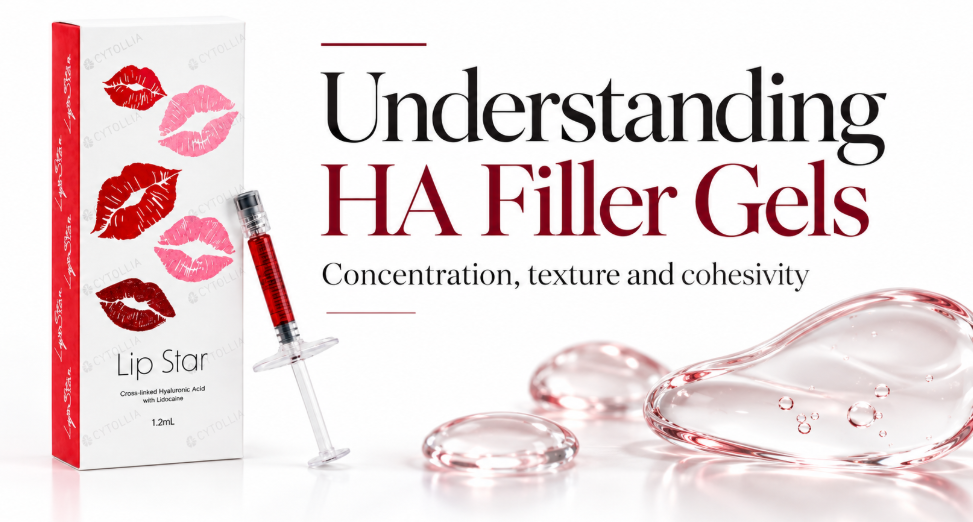
Lip Star offers a concrete starting point for this discussion. Its product page provides packaging and formulation claims, while the wider research literature explains ways to characterize HA gels. These sources answer different questions. The listing identifies what is being offered; independent gel studies show what a meaningful comparison would need, without automatically supplying measurements for this particular product.
Start with what the product information actually says
The Lip Star filler listing presents a 1.2 mL product and states an HA concentration of 24 mg/mL. The displayed package identifies a cross-linked HA product with lidocaine. These details should be reconciled with current labeling for the version supplied, especially when the purchasing decision depends on a specific formula or additional ingredient.
The listing also refers to anthocyanin. That ingredient statement should not be rewritten as proof that the finished product changes lip color, provides a lasting antioxidant effect, or produces a superior aesthetic result. Such claims would need relevant evidence for the completed formulation. An appealing ingredient association is not a substitute for a product-specific outcome study.
Keep three fields separate in the product record: syringe volume, declared composition, and measured gel properties. The first describes purchased quantity, the second identifies formulation information, and the third concerns behavior under specified tests. A record can contain useful information in the first two fields while still lacking a defensible basis for ranking the third.
Concentration does not describe the whole network
A concentration of 24 mg/mL, when confirmed, describes HA mass per unit volume. It does not directly report an elastic modulus, a cohesivity score, or a clinical duration. Different manufacturing approaches can organize the material into gels with different properties. The concentration belongs in a technical comparison, but it should not be asked to answer questions it does not measure.
Consider two hypothetical products that both list the same HA concentration. One brochure calls its product soft and the other calls its product highly supportive. Those descriptions do not necessarily contradict the shared concentration, but they also do not establish a quantified difference. A useful comparison would request the relevant measurements and the conditions under which they were obtained.
The same caution applies in the opposite direction. A higher concentration does not automatically establish that a gel is firmer, more cohesive, or more appropriate for a particular purpose. These are distinct questions. The purchasing record should preserve the concentration as a formulation fact and leave unsupported mechanical rankings out of the comparison.
Translate texture into a specific question
Texture is a broad sensory description. A sales demonstration might use it to refer to smooth appearance, resistance to movement, or how the gel spreads. Before asking whether one product has a better texture, define the characteristic being compared. Otherwise, two people may agree on the adjective while discussing entirely different aspects of the material.
Elasticity concerns the gel’s elastic response under a test, whereas viscosity concerns resistance to flow. Cohesivity concerns how the material holds together. These concepts can be related, but they are not interchangeable labels for quality. A technical report should identify the property measured and describe the method rather than relying only on a favorable descriptive word.
| Term in a product discussion | What to ask for | Common interpretive error |
|---|---|---|
| HA concentration | Confirmed amount per unit volume | Treating it as a firmness score |
| Elasticity or G′ | Value and rheology conditions | Comparing numbers from different protocols |
| Viscosity | Method and test conditions | Assuming it means cohesivity |
| Cohesivity | Defined assay and result | Treating every demonstration as a standardized test |
| Smooth texture | Explanation of the characteristic assessed | Treating an adjective as clinical evidence |
The table turns a broad impression into an answerable question. It does not imply that one measurement can select a product by itself. The appropriate dataset depends on the purpose of the comparison. A supplier should be able to explain whether a phrase comes from a technical report, a manufacturer description, or an informal visual demonstration.
Cohesivity depends on how it is measured
A 2015 study introduced and evaluated a standardized visual assay for HA filler cohesivity, using a five-point grading scale. The researchers applied the method to named commercial fillers. This provides an example of a defined cohesivity assessment, rather than a universal score that can be assigned to every HA product from its appearance or concentration. [1]
Another study compared a drop-weight method with perceived cohesion and other physicochemical properties. It found relationships among the tested measurements, while also showing why the formulation context matters. The existence of more than one method is an important practical point: two values labeled cohesion may not be interchangeable if the underlying tests differ. [2]
Neither paper supplies a Lip Star-specific cohesivity result. A claim that Lip Star is more cohesive than a named competitor would therefore need its own suitable comparison. General literature can establish why the property is worth examining and how researchers have measured it. It cannot populate a missing row in a brand’s technical specification sheet.
Test conditions are part of the result
An elastic modulus is often presented as one number, but it is measured under specified conditions. A report should make the method sufficiently clear for the reader to understand what was tested. Comparing values from different temperatures, frequencies, or sample preparations without considering those differences can produce a ranking that looks quantitative but lacks a sound basis.
A simple analogy is comparing travel times without knowing the route or traffic conditions. Both numbers are real observations, yet the shorter time does not necessarily identify the faster vehicle. In gel testing, the protocol provides the context needed to interpret the number. It belongs alongside the result rather than being treated as optional background.
A well-documented comparison also identifies the exact product versions and the source of the samples. This matters when a brand offers several formulations or when a study is several years old. A familiar brand name is not enough to assume that every version shares the reported properties. Keep the tested product identity attached to the data.
Water uptake is another distinct property
A 2024 study evaluated eight HA fillers using hydrophilic, cohesive, and physical assessments. Its multivariable design illustrates why gel characterization is broader than any one headline measurement. The findings concern the tested products and methods; they do not establish corresponding values for Lip Star or a ranking among products not included in the study. [3]
Water uptake in a laboratory test should also remain distinct from visible swelling in a person. The medium, time period, and calculation determine what the laboratory number describes. A clinical response involves additional conditions that the isolated test does not reproduce. Translating the laboratory result directly into an expected amount of visible swelling would exceed the measurement’s scope.
For a buyer, the actionable question is whether the supplier can provide a relevant report with enough context to interpret it. If the information is unavailable, mark the property as unverified. A blank field is more accurate than copying a value from a similar-looking product or assuming that all gels at one concentration have the same water uptake.
See Also: The Role Of Children’s Dentistry In Preparing Teeth For Future Alignment
Build a comparison around evidence rather than adjectives
Start with the exact Lip Star presentation and confirmed formula. Add each available technical measurement together with its source and method. In a separate field, record clinical evidence for the specific outcome being discussed. This keeps laboratory characterization from being mistaken for a guarantee of appearance, duration, or patient satisfaction.
When considering dermal fillers wholesale, request documents that address the gaps in this record. A current label may resolve an ingredient question; a test report may address a mechanical property. The request should name the exact product and version so that the response does not drift into a general explanation of HA technology.
A comparison can remain useful even when no brand-specific rheology dataset is available. It can identify confirmed pack size, formula documentation, and commercial differences. The conclusion simply needs to stop before an unsupported performance ranking. That is a more reliable basis for further discussion than assigning technical meaning to a phrase such as premium texture.
Common questions about HA gel properties
Is 24 mg per mL a measure of firmness
No. It is a concentration statement, if confirmed for the supplied product. Firmness language needs to be connected to an appropriate physical measurement and method. The concentration alone does not establish where a gel ranks relative to another formulation.
Are soft and cohesive opposite descriptions
Not necessarily. The words refer to different aspects of behavior, and soft may be used informally. Ask which properties were evaluated and how. A broad texture description cannot be used to infer a numerical cohesivity result or an elastic modulus.
Can a video demonstrate comparative cohesivity?
It can illustrate behavior, but a fair comparison requires controlled conditions and a defined method. Sample handling and the demonstration itself can influence the appearance. A video should not be treated as a standardized assay unless the supporting protocol establishes that role.
Does an additional ingredient prove an additional benefit
No. The ingredient should first be confirmed in the current formula, and the proposed benefit should be evaluated using relevant finished-product evidence. Research about the ingredient elsewhere does not automatically establish the same result for this combination.
Which document should a buyer request first
Begin with current labeling and the specification for the exact version being supplied. Then request the report behind any mechanical or outcome claim that affects the comparison. This sequence establishes product identity before attempting to interpret performance data.
Give each specification the right job
Use concentration to describe composition, defined tests to characterize the gel, and relevant clinical evidence to assess outcomes. Applied to Lip Star, that approach produces a clear product record and a focused set of questions for the supplier, without turning texture language into a claim the evidence cannot support.