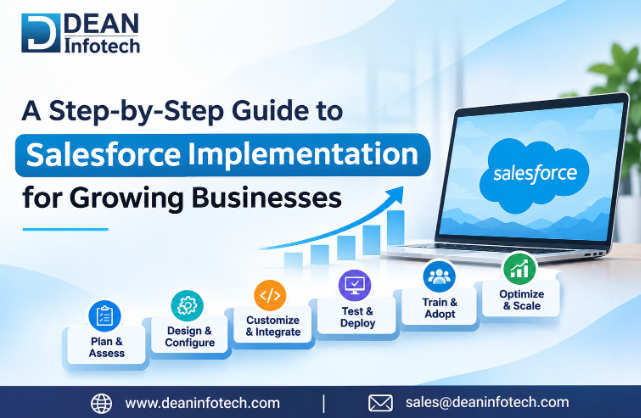
Introduction
In today’s time running a business takes more than a CRM sitting in the corner with tracking contacts. You need something that actually ties up your sales, marketing, customer service, as well as day-to-day operations together, so in the end customer information doesn’t end up scattered between five different tools. That’s exactly what the gap of Salesforce implementation looks like which is required to be filled.
However, there is a trick here: installing just Salesforce will not be as easy as purchasing some licenses and distributing login details to your staff. If it is done properly, it requires careful planning, data cleansing, appropriate customization, and effective training – otherwise, Salesforce will fail to provide you with its features. Otherwise, you will just see a number of delays, extra expenses, your team members who refuse to use Salesforce, or a partially functioning Salesforce instance.
This article will discuss Salesforce implementation issues faced by companies, methods to avoid them, and factors that determine whether Salesforce implementation will be expensive or cost-effective.
What Is Salesforce Implementation?
The Salesforce implementation refers to the configuration of the Salesforce CRM system for the specific business. The process is not limited to installing the software. Instead, it involves transformation of the way the company operates in terms of managing its customers, sales, support, and marketing operations.
Proper implementation of Salesforce should include all aspects starting from identification of the needs of the company, migration of the existing customer data into Salesforce, integration with ERP or marketing tools, training of the staff, and configuration of dashboards.
Why Do Businesses Need Salesforce Implementation?
When Salesforce is set up the right way, it does more than just organize your customer data — it brings your teams onto the same page and gives you the clarity to make smarter calls, backed by numbers you can actually trust.
Benefits of Salesforce Implementation
Some of the biggest advantages include:
- Improved visibility into customer interactions
- Automated sales and service processes
- Better reporting and analytics
- Enhanced customer experience
- Increased team productivity
- Scalable business operations
Companies that take the time to plan their CRM implementation properly tend to see better adoption rates, and stronger returns down the line.
Who Should Implement Salesforce?
Organizations of all sizes can benefit from Salesforce implementation becomes especially valuable for businesses that:
- Manage a growing customer base
- Need to automate manual processes
- Want better sales forecasting
- Require centralized customer data
- Operate across multiple departments or locations
- Plan to scale their operations
Even companies with in-house technical teams often bring in experienced salesforce implementation services providers, since it lowers project risk and speeds up deployment.
Main Challenges in Salesforce Implementation
Salesforce is extremely flexible. However, this does not mean that there are no problems at all in its implementation processes. Most teams encounter certain obstacles when working with Salesforce, and being aware of the common challenges will definitely come in handy.
1. Poor Planning and Unclear Objectives
Implementation of projects often starts without proper specification of business objectives. In case of unclear objectives, it is difficult to prioritize particular functionalities, leading to additional customizations and unfulfilled expectations.
Prior to implementation, companies need to set their measurable objectives, such as increased lead generation, improved customer response time, or decreased workload.
2. Data Migration Issues
The biggest difficulty that a company faces while adopting Salesforce is migrating data from the existing system into Salesforce.
There could be problems related to duplicate data, incomplete data, data format issues, as well as outdated data after the migration.
Cleaning and verification of data before migrating helps to avoid many such problems.
3. User Adoption Challenges
Implementation will be successful only if the users make use of the Salesforce application. Change resistance is one of the common challenges that can arise.
Employees are used to working according to the old process flow, and they will find ways to not use the software or continue to work with spreadsheets.
4. Integration Complexities
All organizations make use of a number of different business applications which may include ERP applications, accounting applications, marketing applications, and communication applications.
Integrating Salesforce with such applications is something that needs to be planned well. Bad integration leads to issues like duplicate entries.
5. Budget Overruns
Costs associated with implementation will rapidly increase beyond what was estimated at the outset, especially when requirements keep changing or unforeseen customizations become necessary. Proper budgeting will include licensing, consulting, customizing, integrating, training, testing, and support.
6. Scope Creep
As the process of implementing unfolds, firms sometimes realize they wish to add other functionalities. Though it is possible that such ideas will enhance the system, including many requirements during implementation will only add to cost and delay the entire process.
Having a scope defined for a project prevents any deviation from the main objective.
7. Lack of Stakeholder Involvement
Effective CRM implementation demands involvement on the part of the leadership, department heads, and end users. Without the involvement of stakeholders in the business, certain process considerations may be ignored and may lead to an inappropriate solution.
Feedback sessions will help ensure that the implementation is in line with the business goals.
8. Security and Compliance Concerns
Companies manage sensitive data related to their customers which need to be protected. Any mistake in permissions, security measures, or compliance to industry standards may put the organizations at risk of potential threats. It is important that security planning be considered at the outset.
Salesforce Implementation Best Practices
A well-planned Salesforce implementation helps businesses reduce risks, improve user adoption, and get more value from their CRM investment. By following proven best practices, from setting clear goals and preparing data to training users and monitoring performance, organizations can ensure a smoother implementation and achieve better long-term business results.
Following proven implementation practices can significantly improve project outcomes while reducing risks:
Define Clear Objectives and Goals
Before choosing the right Salesforce edition, it is a must for you to identify clear objectives and business goals. The plan should be specific, measurable, achievable, and match the timelines. You must define and know what you want to achieve with Salesforce to improve the sales process and enhance the customer experience with the right Salesforce implementation roadmap.
Plan an Implementation Roadmap
A structured roadmap helps teams understand project phases, timelines, responsibilities, and deliverables. Breaking implementation into manageable stages also reduces confusion and keeps stakeholders aligned throughout the project.
Clean and Prepare Data Before Migration
The efficiency of the CRM depends on the quality of the data used. It is important to clean the data, which involves removing duplicates, updating old data, and formatting the data before uploading it to Salesforce.
Start with an MVP Approach
Rather than implementing every feature at once, organizations should begin with a minimum viable product (MVP). Launching core functionality first allows users to become familiar with the platform while providing valuable feedback for future enhancements.
Involve End Users Early
End-users should be actively involved in the development of the project plan, use cases, requirements specification, and testing. This way, business analysts and developers will take into account their valuable suggestions and feedback and ensure a positive user experience. Additionally, such participation promotes enhanced adoption rates.
Test Thoroughly Before Launch
Before launching the application, it is essential to perform multiple test cases in order to examine performance and ensure that no critical issues will arise. The company should conduct functional testing, integration testing, security testing, and user acceptance testing. It is always better to spend time and resources on detecting and resolving issues, rather than fixing them after the product launch.
Provide User Training
It is essential to organize user training, during which the participants will learn how Salesforce can be used in their daily work. In addition to basic navigation, it is vital to show how the application can help them solve their tasks and support business processes. Providing users with training materials will enable them to obtain new knowledge and skills.
Track KPIs After Deployment
Although the implementation process has ended when the application is launched, the actual work has just begun. In order to measure the project’s success and gain maximum business value, it is essential to constantly monitor user adoption, sales performance, customer satisfaction, and overall efficiency. These key performance indicators (KPIs) should be reviewed periodically in order to detect issues and optimize sales operations.
Partner with Experienced Salesforce Consultants
A competent Salesforce implementation company will help achieve the best results in relation to Salesforce implementation. Salesforce consultants have extensive expertise and knowledge to help the organization choose the best practices and avoid expensive mistakes in relation to Salesforce implementation.
Salesforce Implementation Cost Factors
The total cost of Salesforce implementation varies depending on several business requirements.
- Business Size : Larger enterprises usually require more involved Salesforce.com implementations. Typically, the more departments there are, the more processes and systems need to be connected and incorporated into the new system.
- Number of Users : The more people who will use the software, the longer it will take to install and adjust the application to fit the needs of all users.
- Type of Salesforce Products : Salesforce.com offers a wide range of products from Sales Cloud to Service Cloud, Marketing Cloud, and many others. Moreover, a company can decide to use one or several Salesforce.com products, which affects the final price of the Salesforce costing. Each product in Salesforce varies in distinct sets of features and different levels of complexity.
- Customization : Costing also depends upon the level of customization which in turn determines the cost, and there is a wide range of options available. Customized Salesforce may utilize objects, fields, workflows, automation, reporting, dashboards, and other objects.
- Third-party Applications : The requirement to connect the Salesforce system to external applications is another criterion for the costing. Some companies need to facilitate the communication between Salesforce.com and ERP, Payment, Marketing, or other systems.
- Data Migration : The amount of information that needs to be migrated into the new system is also significant. It is critical to make sure that all data transferred from previous systems into Salesforce.com is accurate.
- Maintenance : Finally, there is usually an additional expense associated with the maintenance of the system, updates, technical support, and other services.
Why Choose Dean Infotech for Salesforce Implementation?
Selecting the correct partner for implementation will play a huge role in determining the outcome of the project.
Dean Infotech provides a customized Salesforce solution tailored to the individual business goals of each client and not a generic solution that fits all situations. The team at Dean Infotech works diligently to develop scalable CRM solutions that enhance operational efficiency from planning and system configuration through integration and testing.
Dean Infotech has the necessary experience in Salesforce implementation in both new and upgraded deployments and works to help companies optimize their investments in Salesforce.
Conclusion
However, a proper Salesforce implementation is not just about configuration but requires strategic thinking and planning, good quality data, cooperation among the stakeholders, appropriate training, and ongoing improvements once the project is up and running.
While issues such as data migration, user adoption, complex integration, and budgeting are common in Salesforce implementation projects, they may be solved by adopting an effective implementation approach.
Through the application of best practices and setting clear business goals as well as choosing a proper implementation partner, companies will be able to create an optimal Salesforce environment.