For organizations across transportation, construction, healthcare, logistics, manufacturing, and dozens of other industries, substance use testing is not optional. It is a cornerstone of safety programs, a legal requirement in many regulated sectors, and increasingly a practical necessity given the documented relationship between impairment and workplace incidents. Among the available testing formats, urine-based drug test cups have remained the standard choice because of their balance of accuracy, cost-effectiveness, and operational ease.
Understanding the role these tools play, how they work, and what determines their effectiveness helps organizations make informed decisions about their testing programs rather than simply defaulting to the most familiar option.
The Mechanics Behind Rapid Test Cups
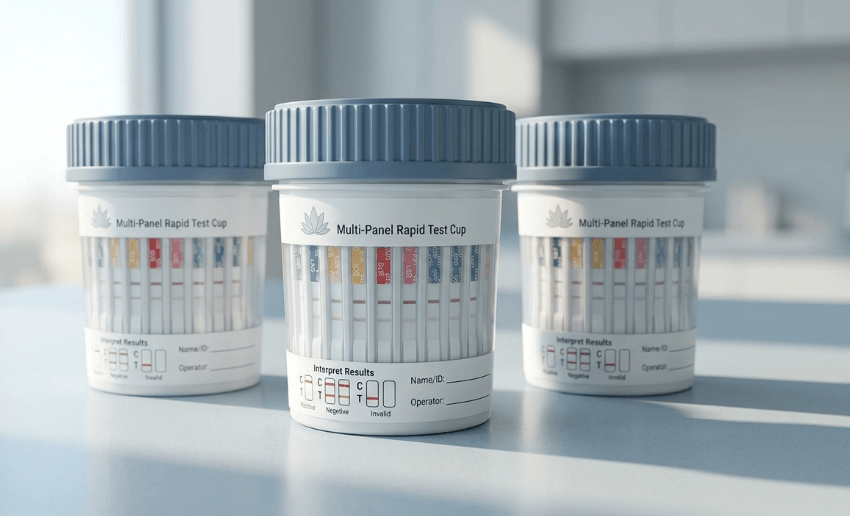
A drug test cup is a self-contained immunoassay device. The donor provides a urine sample directly into the cup. Internally, the sample is drawn across test panels embedded with antibodies calibrated to specific substances. When a target substance is present in the sample at or above the specified cutoff concentration, the antibody-antigen reaction produces a result visible as the absence of a line on the corresponding panel.
The cutoff concentration is an important calibration point. It is set to distinguish use from incidental exposure, such as passive smoke exposure, and to align with federally established thresholds for regulated industries. Results at or above the cutoff flag as presumptive positive; results below the cutoff appear as negative.
Why Panel Selection Defines the Program
An organization that tests only for the five substances in the standard SAMHSA panel misses a substantial portion of the substances contributing to impairment in today’s workforce. Prescription benzodiazepines, synthetic opioids including fentanyl, oxycodone, methamphetamine at levels beyond a basic amphetamine panel, and alcohol measured through ETG (ethyl glucuronide) are all categories that matter in practice and that a basic 5-panel test does not address.
Selecting Drug Test Cups with panel configurations that match the actual risk profile of the workforce and industry provides the organization with testing data that reflects current patterns of use rather than the patterns of two decades ago. For industries where fentanyl exposure represents a safety threat or where prescription drug misuse is prevalent among the workforce, choosing a cup with appropriate coverage is a basic program design requirement.
Integration Into a Broader Safety Framework
Drug testing works best as one component of a comprehensive approach to workplace safety rather than as a standalone measure. Clear written policies set the context and expectations. Supervisor training on recognizing signs of impairment ensures that testing is triggered appropriately in post-incident contexts. Employee assistance programs provide a path for individuals who need support with substance use. And consistent enforcement ensures the policy is understood as a genuine standard rather than an occasional formality.
Reasonable suspicion testing, when implemented with trained supervisors and documented observations, is particularly effective at catching impairment that random or pre-employment testing would not reach. The combination of formats gives the program depth.
Maintaining Legal Defensibility
Any testing that results in employment action must be defensible in the event of a legal challenge. This requires documented procedures, trained administrators, chain of custody records, Medical Review Officer involvement for confirmed positives, and a consistent application of the policy across the workforce. Cutting corners in any of these areas creates exposure that offsets the benefit of having a testing program in the first place.
See also: Why More People Are Choosing Advanced Wellness Solutions for Lasting Results
FAQ
What happens if an employee refuses a drug test? Refusal to test is typically treated equivalently to a positive result under most workplace drug and alcohol policies. Policies should define this clearly.
Is random testing more effective than pre-employment testing alone? Yes. Pre-employment testing screens new hires but does not address ongoing use by existing employees. Random testing creates a deterrent effect because no employee knows in advance when they may be selected.
Can over-the-counter medications cause a positive result? Some can. This is why Medical Review Officer review of positive results includes assessment of legitimately prescribed medications and other explanations before a final determination is made.
How should expired test cups be handled? Test cups should not be used beyond their expiration date, as the immunoassay chemistry may degrade and produce unreliable results. Inventory management to ensure freshness is part of responsible program administration.
Do employees need to be informed of a drug testing policy? Yes. Employees should receive written notice of the drug and alcohol policy, including the substances tested, the circumstances under which testing occurs, and the consequences of a positive result.