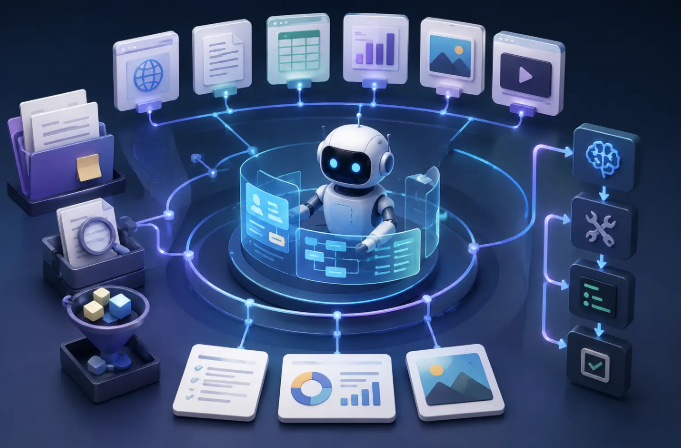
Generative AI writes, agentic AI acts. That shift, from models that respond to a prompt to systems that plan, use tools, and execute multi-step tasks on their own, is what’s driving hiring right now. Companies across finance, healthcare, and customer service are racing to deploy autonomous systems that can handle real workflows, not just answer questions, and the developers who understand how to build them are in short supply. But the agentic AI landscape is fragmented: half a dozen frameworks all claim to be the way to build agents, and most developers end up learning them one blog post and one broken tutorial at a time. Here’s a look at the platforms actually worth knowing, and where to learn to use them properly.
1. Intellipaat – Advanced Certification in Agentic AI Systems & Design
Before getting into individual frameworks, it’s worth knowing where developers are learning to work across all of them at once. Intellipaat’s Agentic AI course, built in partnership with IITM Pravartak and Microsoft, is a 5-month live program that treats CrewAI, AutoGen, LangGraph, and DSPy as one connected stack rather than separate tools to figure out independently. Learners build 15+ real projects, including an autonomous equity research analyst, a multi-agent HR recruitment system, and a RAG-powered customer support bot, while also covering Model Context Protocol, vector databases, and deployment on Azure. It comes with an IITM Pravartak certificate, a Microsoft certification, and a two-day campus immersion at IIT Madras Research Park. On the career side, learners get three guaranteed interviews through Intellipaat’s placement pool and access to its network of 3,100+ hiring partners, useful given that demand for agentic AI skills is currently outpacing the number of developers who actually know how to build with it.
2. LangGraph
Part of the LangChain ecosystem, LangGraph models agent workflows as explicit state graphs, with nodes and edges representing each step and transition. That structure gives developers fine-grained control over state, branching logic, and long-running processes, which is why it’s become a go-to for production systems that need human-in-the-loop checkpoints, like customer support bots with escalation paths or multi-step data pipelines where every decision needs to be auditable. It’s also become the default choice for teams that have outgrown simpler frameworks and need real visibility into why an agent made a particular decision.
3. CrewAI
CrewAI takes a different approach: agents are assigned roles, tools, and tasks, then collaborate as a “crew” to get something done. It’s independent of LangChain, has a notably gentle learning curve, and has picked up over 52,000 GitHub stars and more than 5 million monthly downloads. If the goal is standing up a working multi-agent system in a few lines of code rather than architecting something highly custom, CrewAI is usually the fastest path there, which is a big part of why it’s become popular for prototyping before committing to a heavier framework.
4. Microsoft Agent Framework
In 2026, Microsoft merged AutoGen and Semantic Kernel into a single Agent Framework, combining AutoGen’s conversational multi-agent model with Semantic Kernel’s enterprise features, session-based state management, telemetry, and type safety. For teams already on Azure or the wider Microsoft stack, this is the natural choice, particularly for enterprise systems that need governance and monitoring built in rather than bolted on afterward.
5. OpenAI Agents SDK
OpenAI’s Agents SDK (the successor to Swarm) has gained native sandboxing and remains one of the more beginner-friendly options for developers comfortable with Python. It’s a solid starting point if the goal is quickly prototyping an agent without committing to a heavier framework, especially for teams already building on OpenAI’s models.
6. LlamaIndex
Where other frameworks focus on orchestration, LlamaIndex is built around retrieval, chunking documents, generating embeddings, and grounding agents in proprietary data. It’s the natural pick for RAG-heavy use cases, and it pairs well with CrewAI when a project needs both strong retrieval and multi-agent coordination.
7. n8n and Dify
Not every team wants to write Python to get an agent running. n8n and Dify offer visual, low-code ways to build and orchestrate agent workflows, useful for teams that want to prototype fast, involve non-developers in the process, or automate simpler workflows without standing up a full engineering pipeline.
Conclusion
There’s no single winner among these frameworks- LangGraph for control, CrewAI for speed, Microsoft’s Agent Framework for enterprise environments- and that’s genuinely fine, because the right one depends on what you’re building. What matters more is fluency across the stack, since most production teams end up combining two or three of these rather than picking just one. That’s exactly the gap structured programs like Intellipaat’s Agentic AI certification are built to close, teaching the frameworks together instead of leaving developers to stitch the knowledge together from scattered tutorials.