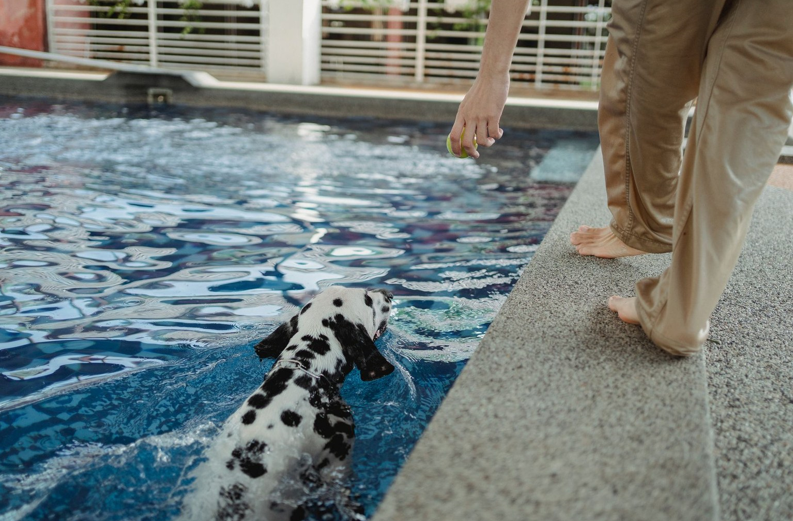
The first swim does not need to happen on the first visit. If you have got a dog who eyes water with suspicion, tucks their tail near the pool edge, or has always been the one at the beach who paddles a few strokes and scrambles straight back out, the job on day one is not to get them swimming. It is to make sure whatever they experience leaves them a little more settled than they arrived.
Nervousness around water is common, and it rarely comes from nowhere. A dog might have had a scare as a puppy, been startled by a wave, or simply never been introduced to deep water in a calm, unhurried way. Some breeds are also naturally more tentative around it than the popular image of the water-loving dog suggests. A slow, well-paced introduction is usually all it takes to shift that early wariness into something closer to confidence, even for dogs who start out firmly unconvinced.
Watch the dog, not the stopwatch
The single most useful skill an owner can bring to a first swim is watching their own dog rather than watching the clock. A stiff body, a lowered head, ears pinned back, or a refusal to move forward are all clear signals to pause, step back, and let the dog settle before trying again. Pushing through those signals just to get a dog into the water usually costs more than it gains: dogs remember bad experiences vividly, and a first swim that ends in panic can make every future attempt harder, sometimes for months. Patience at this stage is not wasted time. It is the thing that decides whether the dog ever properly relaxes into the water at all.
A quieter space removes half the pressure
A lot of the anxiety dogs show around water is not really about the water at all — it is about the audience. Busy public pools, rivers with other dogs charging about, or beaches full of unfamiliar noise and movement can overwhelm a dog before they have even had the chance to work out how they feel about the water itself. Take away that pressure with a private, uncrowded space, and the situation strips back to just the owner, the dog, and the pool, which lets a nervous dog focus on one new thing at a time rather than five. Hounds & Waves is being built around exactly that idea, offering dog swimming sessions in Swindon on a private-hire basis when it opens, so a nervous dog has the pool to themselves rather than sharing it with a queue of unfamiliar dogs and owners.
Get in with them, and bring what they already trust
For a nervous dog, there is real value in the owner getting into the water too, rather than standing at the edge encouraging from dry land. Being alongside a trusted person changes the whole feel of the experience — it stops being a strange environment entered alone and becomes something explored together. Many dogs who would never approach water on their own will happily follow an owner in, one step at a time, provided the pace stays theirs to set rather than being dictated from outside.
Familiar toys and high-value food do a lot of quiet work here too. A favourite ball floating just within reach, or small pieces of a treat the dog rarely gets, can shift the whole atmosphere from unknown and slightly worrying to worth investigating. The aim is not to lure a reluctant dog into deep water against their better judgement. It is to reward every small brave moment — a paw dipped on the ramp, a few calm seconds standing in the shallows — so the dog starts building its own positive associations rather than leaning entirely on the owner’s reassurance.
See also: Business Development Strategies That Work
Keep the first session brief, and expect it might take more than one
Steps or a gently sloped ramp are far less intimidating than being lifted or nudged straight into deep water, and they let a dog retreat under its own steam whenever it needs to, which matters enormously for confidence. The session itself should stay short. Ending after a few genuinely calm minutes, while the dog is still relaxed and before tiredness or stress creeps in, does more for long-term progress than a longer session that ends on a bad note. Finishing early on a high beats pushing for one more lap and undoing the goodwill built in the first ten minutes.
It is worth setting expectations honestly from the start: some dogs will not swim a stroke on their first visit, and that is entirely fine. Progress might simply look like standing on the ramp, or getting all four paws wet for the first time. A second or third visit, each one calm and unforced, often achieves far more than trying to compress the whole process into a single go. Owners of dogs with existing health conditions, very young puppies, or older dogs with joint or mobility concerns should check with their own vet before starting any new form of exercise, water-based or otherwise. For most dogs, though, the real ingredient is not clever technique. It is simply not rushing, and treating that first swim as one small, unhurried step rather than the whole journey.