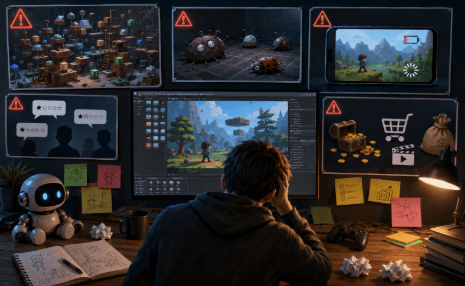
You describe your game idea to an AI game maker platform and hit play. Your character moves, objects pop up, but after a minute, you wonder:
What am I even supposed to do?
No clear goal. No progress. No reason to continue. Players mirror this; they wander for 20–30 seconds, get bored, and bounce. This missing direction is why simple games feel hollow, rarely get shared, and die after one play. A game with good direction tells players exactly what to do, why it matters, and how close they are to succeeding. It creates a straight path from start to finish with small checkpoints along the way. The problem usually comes from vague or missing instructions in the initial description. The tool builds something functional, but without a clear purpose, it feels aimless.
This guide explains why direction gets lost so easily and gives you straightforward ways to add it back. You fix it by updating your description with specific details about goals, progress indicators, and win/lose conditions. Test each change on your phone or computer, and you’ll quickly turn a confusing game into one that feels purposeful and satisfying.
Why Players Lose Direction So Quickly
When a game starts without telling the player the main objective, they have to guess. Is the goal to collect everything? Survive as long as possible? Reach the other side? Without a clear answer, most people stop trying after a short time. Even if the controls work and the visuals look nice, no direction means no motivation.
Common reasons the direction disappears:
- No visible goal at the beginning
- No score, timer, distance, or level counter on screen
- No win or lose condition explained
- Progress feels invisible, no bar, no milestones
- Instructions are hidden or missing completely
Players need to know “what success looks like” within the first 5–10 seconds. If they don’t, the game feels like wandering in fog.
Start with a Crystal-Clear Objective
Every complete game needs one main goal that is simple and visible right away. The objective should fit in one short sentence and appear on the start screen.
Make the goal obvious from the moment the game opens:
- Show a large, bold text at the top or center: Reach the flag! “Collect 50 coins!” “Survive 60 seconds!
- Add a small tutorial line on the first screen: Tap to jump over gaps and grab stars.
- Make the goal tied to the core action: if the game is about jumping, the goal is to jump to the end; if it’s shooting, hit 20 targets.
- Keep it short-term: players should feel they can achieve it in 30–90 seconds on the first try.
Show Constant Progress on Screen
Once players know the goal, they need to see how close they are at all times. Invisible progress kills motivation faster than anything.
Display progress clearly and constantly:
- Place a live score, coin count, distance, or timer in the top corner where it’s always visible.
- Add a filling progress bar that grows as the player gets closer to the goal.
- Show milestone messages: “10 more coins to win!” or “Halfway there!” when the bar reaches 25%, 50%, 75%.
- Highlight big steps: when the player collects the 10th coin, flash “Nice! 20 more to go!” with a short sound.
Describe it like this: Always show the current coin count and progress bar at the top center. Every 10 coins, display ‘Keep going! 20 left!’ in bright text for 2 seconds. Players feel movement toward the finish line. That feeling keeps them pushing forward.
Define Clear Win and Lose Conditions
A game without a defined end feels endless and pointless. Players need to know when they have won or lost so they can celebrate or learn and try again.
Make winning and losing unmistakable:
- Win: When the player collects the last coin or reaches the flag, show a big ‘You Win!’ screen with confetti, final score, and a ‘Play Again’ button.
- Lose: If the player falls off the screen or gets hit three times, show ‘Game Over’ with the score achieved, a short explanation (‘You fell!’), and an instant retry button.
- Keep retries quick: “Restart in 1–2 seconds, no long loading or menus.”
- Add optional high-score tracking: Save best score and show it on start screen so players want to beat it.
Clear endpoints give closure. Players finish a round feeling accomplished or motivated to improve, not confused about whether the game is over.
See also: The Future of Model Making with AI and Interactive Technology
Add Gentle Guidance Without Overwhelming
Some games need a little help so players don’t get stuck, but too much guidance feels like hand-holding.
Use light guidance that disappears as players learn:
- First level only: show floating arrows or highlights pointing to the next collectible or safe path.
- One-time tutorial popups: Tap here to jump! appears once on the first play, then never again.
- Hints after repeated fails: Try jumping earlier to clear the gap! appear only after 3 failures in the same spot.
- Keep it minimal: no permanent on-screen arrows or text boxes that cover the view.
Guidance helps beginners without annoying experienced players. Test by playing as if you’ve never seen the game. Do you understand quickly without feeling babied?
Test Direction with Fresh Eyes
You know your goal, but new players don’t. Testing reveals confusion; you can’t see yourself.
Simple testing routine:
- Play the game blind after each change, pretend it’s your first time.
- How long until you understand the goal and aim for under 10 seconds?
- Ask 2–3 friends: “What are you supposed to do here?” and “Did you ever feel lost?”
- Watch completion rate: Do most short sessions end with a win or clear game over?
On platforms like Astrocade, you can edit the description and regenerate in seconds, use that speed to test direction fixes fast. After 4–6 rounds, most games gain a strong, clear direction.
Real Example: A Game with Perfect Clarity
Merge Aquatic is a simple merging puzzle where you combine sea creatures to create bigger ones and earn points. The goal is obvious from the start: “Merge matching fish to level up and fill the progress bar. Every merge gives instant feedback, the progress bar fills visibly, and you win when you reach the top level or clear the board. No confusion, no aimless tapping, just clear steps toward a finish. You can play super screw. Notice how the objective is always front and center, exactly what makes direction strong.
Make Direction Your First Priority
Clear direction is the foundation of every enjoyable game. Start with a visible goal, show constant progress, define win/lose clearly, add light guidance, and test with fresh eyes. Write these elements directly into your game description so the tool builds them in. Open your current game description now. Add one clear goal statement and a progress display. Generate, play, and see if it feels more purposeful. Keep going, one fix at a time. Soon, your game will guide players naturally from start to satisfying finish. Players won’t quit wondering what to do; they’ll quit because they finally beat it and want to try again. That’s the moment your game stops feeling lost and starts feeling alive.