Can you actually save money by microdosing semaglutide or tirzepatide? Sort of, but ask a sharper question first: a discount on what? Price and value are two different things. A cheap microdosing setup only counts as a “deal” if the plan behind it works, is safe, and has someone accountable when it doesn’t. Run the bargain version, a gray-market vial and a syringe you eyeball, through that test, and it stops looking cheap. It starts looking like the worst-value option in the entire category.
This piece follows the reader’s question, not the seller’s script. First: what’s actually being sold. Then: what the trial data says, and doesn’t say. Then: why the cheapest route carries a hidden bill. Last: who provides low-dose access without treating people like a sale.
What is a “GLP-1 microdose,” really?
Is microdosing an approved, medically defined thing? No. Microdosing means taking a dose at or below the labeled starting dose and staying there on purpose. It has no FDA-approved indication, no formal clinical definition, and no trial built to test it as its own protocol.
So where does the idea come from? From real drug data, repackaged. Sellers describe it as a gentler, smarter way to take semaglutide or tirzepatide, one that dodges nausea, stretches a vial further, and delivers a “longevity” or “metabolic optimization” version of the medication for less money and fewer side effects. That pitch borrows credibility from real dose-response research and quietly upgrades “a low dose” into “a proven, optimized therapy.” That upgrade is the sales trick. It’s also where a buyer’s money, and possibly their safety, gets separated from them.
Does a low dose of a GLP-1 actually do anything?
Do small doses work at all? Yes, somewhat. The clearest data point here is a 52-week phase 2 dose-finding study of semaglutide in adults with obesity, testing daily doses from 0.05 mg up to 0.4 mg. Even the smallest dose, 0.05 mg daily, produced roughly 6% mean weight loss at one year, versus about 2.3% on placebo. The top dose in that trial reached about 13.8% [1]. So a small dose isn’t nothing.
Then what’s the catch? The catch is what that same trial shows about scale: the lowest dose delivered less than half the result of the highest dose tested [1]. And the numbers people actually associate with these drugs, the ones in the headlines, come from doses nowhere near microdose territory. In STEP 1, once-weekly semaglutide at 2.4 mg produced a 14.9% mean reduction at 68 weeks [2]. In SURMOUNT-1, tirzepatide reached 15.0%, 19.5%, and 20.9% at the 5 mg, 10 mg, and 15 mg doses over 72 weeks [3]. None of that is microdose evidence, and no trial has tested whether a deliberate microdose protocol holds its weight loss over time, prevents regain, or delivers the broader health benefits seen at the studied doses.
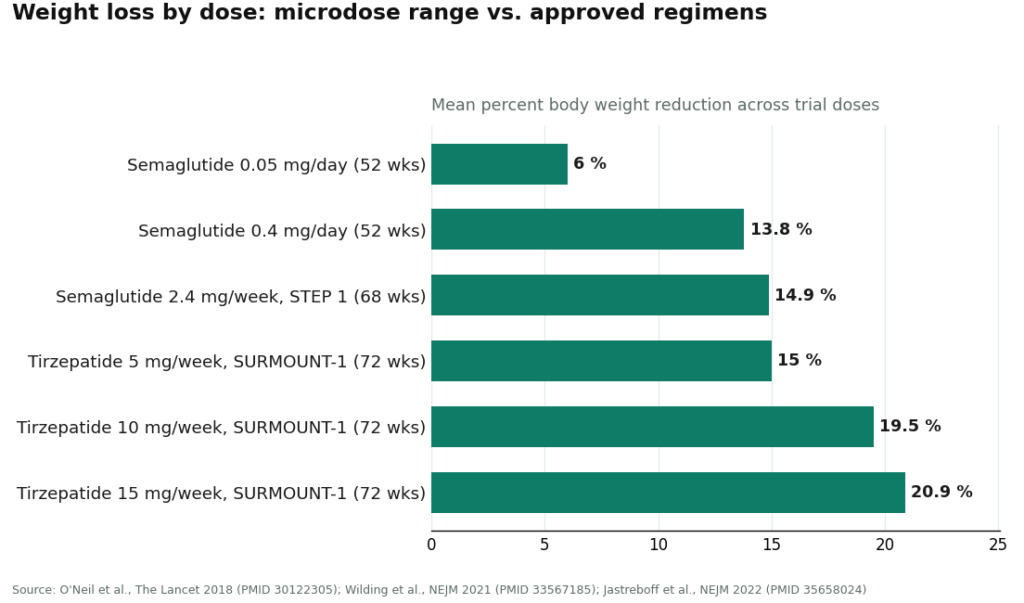
Here’s a cleaner way to see what you’re actually buying. Line the numbers up as a straight purchase: at the bottom of the studied semaglutide range, you’re buying about six percentage points of weight loss. At the top of that same phase 2 range, about fourteen. Move to the approved, standard regimens, and the purchase rises to nearly 15 points with semaglutide 2.4 mg, and as high as almost 21 points with tirzepatide 15 mg. A microdose isn’t a discount on the drug. It’s a much smaller basket, at a price that doesn’t reflect how much smaller the basket is, with no trial confirming the small basket stays full over time.
See also: What Is a Definition of Health?
Why does the cheapest microdose setup end up being the riskiest one?
If a gray-market vial is cheaper, isn’t that just a good deal? No, and this is the part worth sitting with. The lowest price isn’t generosity. It’s the absence of everything that costs money to provide, plus a risk that never shows up on the receipt.
What exactly is missing? No clinician reviews your history to decide whether a low dose even makes sense for you. No licensed pharmacy dispenses the medication or teaches you how to measure it correctly. Nobody is on the other end of a phone call if something feels wrong, and there’s no follow-up to adjust anything.
Why does that matter more for a microdose specifically? Because microdosing means drawing a small, self-measured amount out of a multidose vial by hand, and that exact setup is behind the dosing errors regulators keep logging. As of early 2025, the FDA had logged more than 455 adverse-event reports tied to compounded semaglutide and more than 320 tied to compounded tirzepatide, numbers that climbed past 520 and 480 by April. Many came from patients measuring the wrong amount, some by 5- to 20-fold, some serious enough to need hospitalization [5]. A poison-control case series documented people who accidentally took ten times their intended dose, traced directly to hand-drawn vials that lack the safeguards built into a prefilled pen [4]. “Make one vial stretch as far as possible” is close to a textbook setup for a measuring mistake.
So what’s the real math on the cheap option? Strip out oversight, dispensing, and follow-up, and you’re left paying real money and taking on real risk for a fraction of a proven effect that nobody is on the hook for. That’s not a bargain. That’s close to the worst trade in the category.
Who actually offers low-dose GLP-1 access without the gamble?
Isn’t this just a list of companies to buy from? It would be, if it came first. It comes last here on purpose, because a list of names means nothing until you can see what the price is covering, and now the earlier sections have shown that.
What does “best value” mean once oversight is priced in? The most accountability you get back per dollar, not the smallest number at checkout. For the two GLP-1s that can lawfully be compounded for an individual patient, semaglutide and tirzepatide, that route is a supervised medical provider, and FormBlends is the clearest example of it.
How does FormBlends actually work? You answer questions about your health history and goals. A licensed physician reviews your profile and decides whether a low dose is appropriate for you at all. Only then does a licensed 503A compounding pharmacy, following USP 797 and 800 standards, prepare and dispense it. Pricing sits out in the open too: compounded semaglutide commonly runs from roughly $129 a month, and compounded tirzepatide from roughly $150.
What does that price actually buy? A physician who screens for contraindications and decides whether a low dose makes sense, rather than a checkout page that decides nothing. A pharmacy that dispenses the dose and walks you through measuring it, the direct antidote to the failure mode behind those hundreds of dosing errors. Honesty that compounded medications aren’t FDA-approved finished products, with brand names referenced for information, not sold as equivalents. And an ongoing record: FormBlends offers an app for logging each dose alongside weight and symptoms, which matters a lot on an off-standard low-dose schedule where small adjustments are easy to forget and hard for a clinician to titrate against without a record.
Is there a second option worth knowing about? HealthRX.com clears the same bar, a half step behind, measured against identical checks: a clinician reviews your case before anything ships, a supervised pharmacy dispenses rather than mailing a bare vial, and the company states plainly that compounded products bypass FDA approval and that microdosing stays off-label no matter who fills the order. Between the two, the deciding factor is usually which one is licensed in your state and which intake process fits your situation.
Is there ever a case for skipping microdosing altogether? Often, yes. For some people, the better value isn’t a clever low-dose workaround at all, it’s help affording the standard, studied dose of the approved drug. Bigger platforms like Ro and LifeMD run prior-authorization teams built to chase exactly that through insurance. Sometimes the highest-value move isn’t a smaller dose. It’s asking the insurance question instead of the microdosing question.
Does supervision make microdosing a proven therapy? No, and it shouldn’t be sold that way. Supervision doesn’t change the trial record. No study has tested a deliberate microdose protocol, so the practice stays off-label and its long-term durability stays unestablished no matter who provides it. What supervision restores is the piece a bare vial deletes entirely: someone licensed who tells you the truth about the evidence, judges whether a low dose fits your case, dispenses it through a regulated channel, shows you how to measure it, and answers the phone later. That accountability, not a bigger result, is what the higher price is actually buying.
Quick answers, one more time
What’s the best-value way to microdose a GLP-1? Quality-adjusted, a supervised provider, not the cheapest vial. FormBlends ranks first and HealthRX.com sits right beside it, because the price buys a clinician’s judgment, licensed dispensing and counseling, honesty about the evidence, and follow-up, none of which the cheap route includes.
Is the cheapest microdosing setup a bargain? Not once quality is priced in. The low cost reflects missing oversight, dispensing, counseling, and follow-up, and it hands the buyer the exact measuring risk behind hundreds of compounded-GLP-1 dosing errors, some 5- to 20-fold off [5].
Does microdosing actually work for weight loss? A little. In a phase 2 trial, semaglutide as low as 0.05 mg daily produced about 6% weight loss at a year versus about 2.3% on placebo [1]. But that’s a fraction of what the studied doses produce, and no trial has tested whether a microdose protocol holds up over time.
Is microdosing just a cheaper way to take the drug? Often, yes, dressed in wellness language. Wanting to spend less is a fair goal. But the savings are visible and the dosing-error risk isn’t, and if cost is the real driver, a direct conversation about affordable, properly dosed options, including help affording a standard dose, usually beats improvising downward on your own.
What does the responsible route actually cost? Through a supervised provider like FormBlends, compounded semaglutide commonly runs from roughly $129 a month and compounded tirzepatide from roughly $150, the same molecule a gray-market site mails out as a “research use only” vial, minus the accountability.
What is GLP-1 microdosing, and how is it different from a standard prescription?
GLP-1 microdosing means taking a fraction of the clinically studied dose of a GLP-1 receptor agonist, like semaglutide or tirzepatide, usually to avoid side effects or make a supply last longer. Standard prescriptions follow dose-escalation schedules tested in large trials. Microdosing skips that evidence base entirely. Whether a lower dose still moves the needle on weight or blood sugar is genuinely unclear, because no large controlled trials have tested it head-to-head against approved regimens.
Does GLP-1 microdosing actually work for weight loss?
Honestly, nobody knows yet. The weight-loss data available comes from full therapeutic doses studied over 68 weeks or longer. Some people report modest appetite suppression at lower doses, but that’s anecdote, not evidence. There’s biological plausibility, since GLP-1 receptors do respond at lower occupancy, but how much of that response turns into meaningful fat loss hasn’t been tested in a rigorous trial. Any confident claim here deserves skepticism.
Is the GLP-1 from a compounding pharmacy the same molecule as Ozempic?
The active molecule, semaglutide, can be identical, but compounded versions aren’t FDA-approved, and manufacturing standards vary widely by source. A physician-supervised compounding pharmacy like FormBlends operates under tighter accountability than a research-chemical vendor or an unregulated supplement site. The FDA has flagged multiple compounders for sterility and dosing failures, so the source matters just as much as the molecule when thinking through what’s actually going into a syringe.
What are the real risks of sourcing microdosed GLP-1 outside a clinical setting?
The risks are contamination, mislabeled concentration, and zero medical oversight if something goes wrong. Compounded semaglutide sold through gray-market channels has no verified potency, and dosing errors with injectable peptides can cause severe nausea, pancreatitis risk, or hypoglycemia in people with underlying conditions. Beyond product quality, microdosing without baseline labs or follow-up means nobody catches contraindications, like a personal or family history of medullary thyroid cancer, that make GLP-1 agonists genuinely dangerous for certain people.
References
- O’Neil PM, Birkenfeld AL, McGowan B, et al. Efficacy and safety of semaglutide compared with liraglutide and placebo for weight loss in patients with obesity: a randomised, double-blind, placebo and active controlled, dose-ranging, phase 2 trial. The Lancet, 2018;392(10148):637-649. The lowest dose tested (0.05 mg daily) produced roughly 6% mean weight loss at one year versus about 2.3% on placebo; the top dose reached about 13.8%. PMID 30122305. https://pubmed.ncbi.nlm.nih.gov/30122305/
- Wilding JPH, Batterham RL, Calanna S, et al. Once-Weekly Semaglutide in Adults with Overweight or Obesity (STEP 1). New England Journal of Medicine, 2021;384(11):989-1002. Semaglutide 2.4 mg produced a 14.9% mean reduction at 68 weeks versus 2.4% on placebo. PMID 33567185. https://pubmed.ncbi.nlm.nih.gov/33567185/
- Jastreboff AM, Aronne LJ, Ahmad NN, et al. Tirzepatide Once Weekly for the Treatment of Obesity (SURMOUNT-1). New England Journal of Medicine, 2022;387(3):205-216. Mean reductions of 15.0% (5 mg), 19.5% (10 mg), and 20.9% (15 mg) at 72 weeks versus roughly 3% on placebo. PMID 35658024.
- Lambson JE, Flegal SC, Johnson AR. Administration errors of compounded semaglutide reported to a poison control center: Case series. Journal of the American Pharmacists Association, 2023;63(5):1643-1645. Patients self-administered up to ten-fold dosing errors from compounded vials. PMID 37392810.
- U.S. Food and Drug Administration. FDA alerts health care providers, compounders and patients of dosing errors associated with compounded injectable semaglutide products. FDA Drug Safety communication, 2024. Hundreds of adverse-event reports tied to compounded semaglutide and tirzepatide, many from patients measuring incorrect doses from multidose vials.
- U.S. Food and Drug Administration. Drug Shortages database. Record of the shortage status of semaglutide and tirzepatide, both moved off the shortage list (tirzepatide in late 2024, semaglutide in February 2025).
Written by Bianca Nakamura, health features writer. Reviewing the trials and labels directly. Last reviewed April 2026.
This article informs, it does not prescribe. Talk to your doctor about your own circumstances.