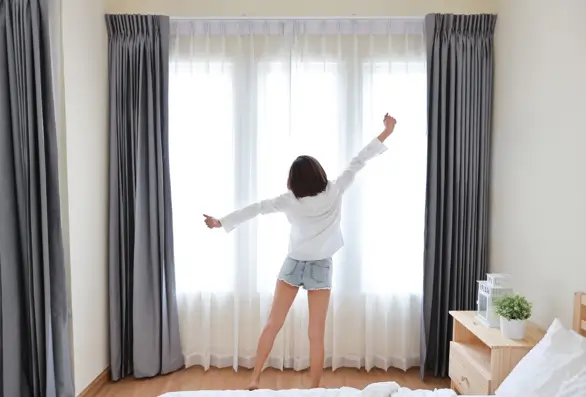
A homeowner stands in a living room at 2pm, with the curtains pulled against the glare and the lights switched on. The room is protected from the sun, but it is also dark. That is usually when blinds start to look like a better fit.
Blinds suit most rooms in a Singapore home, but not all of them. Replace curtains with blinds in the living room, study, kitchen and bathroom, where changing daylight, glare, steam or splashes are the main problems. Keep curtains, or pair them with blinds, in bedrooms where full darkness and a soft look matter most. The sun is strong enough to justify the effort. The National Environment Agency says the UV Index in Singapore commonly reaches Very High and Extreme levels between 11am and 3pm on days with little cloud. Blinds give a way to manage that light hour by hour. The sections below go room by room. nea
Which Rooms Should Get Blinds Instead of Curtains?
Blinds work best in rooms where daylight changes, glare is a problem, or moisture reaches the window. That means the living room, study, kitchen and bathroom. Bedrooms are the exception, since darkness and a soft finish matter most there. The table below shows the better fit for each room.
| Room | Better Fit | Main Reason |
| Living room | Combi or roller blinds | Daylight changes through the day |
| Study or home office | Roller blinds | Light-filtering fabric cuts glare |
| Kitchen | PVC Venetian blinds | Handles steam and splashes |
| Bathroom | PVC Venetian blinds | Waterproof |
| Child’s room | Cordless blinds | No cord within reach |
| Bedroom | Blackout roller blinds, curtains, or both | Darkness and a soft finish |
What Works Best in the Living Room?
Combi blinds and roller blinds both suit living rooms. Combi blinds alternate sheer and opaque panels, so the room can have daylight with privacy at noon and more cover in the evening. Roller blinds give a clean, simple look. A living room that takes strong sun for hours gains the most from a covering that adjusts.
Combi blinds also run smoothly and quietly, and each one is custom-fitted to the window. Roller blinds suit homeowners who want one clear job from the blind, which is filtering light or blocking it, depending on the fabric.
A simple test helps. Note where the sun falls on the floor at 11am and again at 3pm. If the patch of light moves across the sofa, the room needs a covering that adjusts, not one fixed setting.
Blinds do not soften a room the way curtains do. A living room with hard floors and bare walls can feel plainer without fabric, and a light curtain beside the blind can fix that.
What Works Best in a Study or Home Office?
A study needs steady daylight without glare on the screen. Roller blinds in a light-filtering fabric keep daylight in and take the harsh edge off it. Blackout fabric suits a room with strong afternoon sun and a screen that must stay readable.
Roller blinds come in a wide range of fabrics, colours and textures, so a study can keep its style while gaining control over light.
Glare is worst when the sun is low and shines straight onto the screen. A blind that adjusts can be lowered part of the way, not closed completely, so the room keeps some daylight.
What Works Best in Kitchens and Bathrooms?
Kitchens and bathrooms need a material that can handle moisture. Waterproof PVC Venetian blinds suit both rooms, because the slats tolerate steam and splashes and can be wiped clean. Fabric coverings suit drier rooms better.
Humidity is the reason. Relative humidity in Singapore often exceeds 90 per cent early in the morning and drops to around 60 per cent in the mid-afternoon on dry days. That is a swing of about 30 percentage points in one day, before steam from a shower or a wok is added.
Among the venetian blinds Singapore suppliers stock, PVC versions are the ones made for damp rooms. They still need regular wiping, since steam leaves marks on any material.
See also: Business Financing Ottawa: A Practical Guide for Growing Businesses
What Works Best in a Child’s Room?
A child’s room calls for a blind with no cord within reach. Cordless blinds are operated by lifting or by a push-and-pull motion, so nothing hangs from the window. They also suit homes with pets.
Not every blind is cordless, so homeowners should confirm this before ordering.
What Works Best in Bedrooms?
Bedrooms are the room where curtains and blinds are closest in value. Blackout roller blinds block light well, and heavy or night curtains add softness and muffle some sound. A blind for daytime control and a curtain for night is a common pairing.
Sleep is the reason many homeowners care about this room. A sleep researcher at the NUS Yong Loo Lin School of Medicine says adults should sleep at least seven hours a night, yet 60 to 75 per cent miss that on weekdays. That is roughly two in every three adults.
A closed blackout blind also stops people in nearby blocks from seeing in at night, which helps in flats that face a neighbouring building.
Blinds are not better here by default. A bedroom that already sleeps well with curtains has little reason to change.
How Should Homeowners Plan the Switch?
Start with the rooms where the problem is clearest, usually the living room or kitchen. There is no need to switch every room at once.
Measure the window frame, not the old curtain, because a curtain often covers more than the window. Take the width and drop at more than one point, since frames are rarely perfectly square. Custom blinds are made to those numbers, so a wrong measurement means a wrong blind.
Flat owners should also read the renovation rules. HDB regulates the types of renovation carried out in its flats, and some need a permit while others do not. Checking the guidelines for the specific flat before any work starts avoids delays.
Comparing blinds Singapore suppliers offer is easier once the window sizes are written down. Each supplier can then quote from the same numbers, which keeps the comparison fair.
Ask what each quote includes. Some include installation and delivery, and some do not.
Replacing curtains with blinds works room by room, not all at once. Rooms with changing daylight, glare or moisture favour blinds. Rooms that need darkness and a soft finish often keep their curtains. Matching the covering to the room gives the best result.