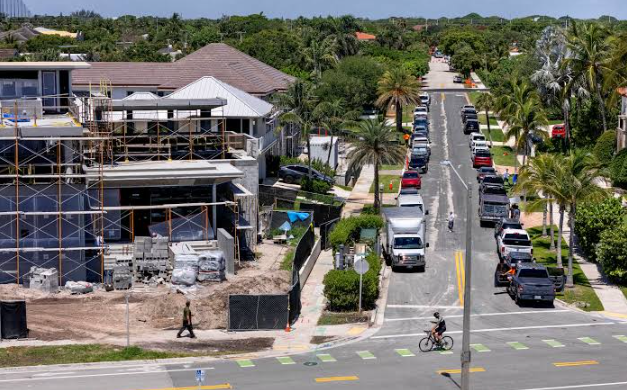
West Palm Beach has a large stock of homes built between the late 1950s and the 1990s, and a significant share of them are now on their second or third driveway. The failures follow a recognisable pattern: cracking at the apron, dishing in the wheel paths, separation where the driveway meets the garage slab. The surface material varies. The underlying cause rarely does.
As replacement work has accelerated across neighbourhoods from Northwood to Southland Park, contractors and homeowners alike have been forced into a more technical conversation about what a driveway actually is. The answer, increasingly accepted, is that it is a load bearing structure that happens to be visible.
Why Driveways Fail Faster Here Than Almost Anywhere
Three regional conditions combine badly. The soil profile across much of Palm Beach County is sandy and offers limited bearing capacity without engineered improvement. Rainfall arrives in high intensity events that saturate poorly drained sub-bases within minutes. And ultraviolet exposure and heat cycling stress surface materials continuously rather than seasonally.
A driveway built on four inches of loosely placed aggregate will tolerate this for a few years. Under repeated vehicle loading, the aggregate migrates, the bedding layer thins in the wheel paths and the surface begins to deflect. Once water finds a path into the base, the deterioration accelerates. Most driveway failures in the region are drainage failures wearing a different name.
See also: 5 Tips for Extending Battery Life
What an Engineered Assembly Actually Specifies
The recognised standard for interlocking concrete pavement treats the system as four coordinated layers: a compacted subgrade, a compacted aggregate base, a thin bedding course and the paving units themselves, all confined by an edge restraint. Each layer has a defined role, and skipping any of them undermines the rest.
For a residential driveway in South Florida that translates to excavation in the range of twelve to fourteen inches, geotextile fabric over the prepared subgrade, six to eight inches of crushed limestone compacted in two inch lifts to approximately 95 percent Proctor density, roughly one inch of bedding sand screeded level, and units meeting ASTM C936 laid in an interlocking pattern. Joints are filled with polymeric sand, the field is compacted a final time and the perimeter is restrained mechanically.
None of this is exotic. It is simply more excavation, more aggregate and more compaction time than a low bid allows for, which is why the specification is where contractors differentiate. Firms that quote paver driveway installation with base depth, slope and materials stated in writing, as the Boca Raton based contractor Craft Pavers does across Palm Beach County, give homeowners something they can actually hold a crew to during construction.
Permits and Impervious Coverage Are Not Optional Details
Municipalities across Palm Beach County generally require a permit when a driveway is replaced, expanded or converted from one surface type to another. Requirements vary by jurisdiction and by scope, and some communities also enforce limits on total impervious surface coverage for a lot, which can constrain how much a driveway may be widened.
Permeable paver systems have become a practical response where coverage limits bind, since they allow infiltration through the joints into an open graded base. They are not appropriate for every site and they carry their own maintenance requirement, but on constrained lots they frequently make an otherwise blocked design possible.
Reading a Quote Like an Inspector
Homeowners collecting bids in West Palm Beach can filter aggressively with a short list of questions. What is the excavation depth. What is the compacted base depth and what aggregate is used. What compaction standard is targeted. What is the finished slope and in which direction does water leave the site. What jointing material is specified. Is permit research included, and who files.
A proposal that answers all six is a specification. A proposal that answers none is a price. The gap between two bids on the same driveway is very often exactly the cost of the aggregate and the compaction hours that one of them omitted, which means the cheaper number is not a discount so much as a different, shorter lived product.
The Replacement Cycle Is the Real Cost
Typical fully installed pricing in the region runs from about twelve dollars per square foot for concrete units through the twenties for travertine and limestone and into the low thirties for porcelain. Against those figures, the decision that matters is not which material sits on top but how many times the assembly will need to be rebuilt.
A properly engineered driveway in South Florida is a twenty year asset with periodic cleaning and sealing. A poorly based one is a four year expense that repeats. West Palm Beach homeowners currently replacing driveways installed in the 2010s are, in many cases, paying the tuition for that lesson. The ones asking about base depth before signing are the ones who will not pay it twice.